Blog: Music Industry
Read our latest daily deep dives, hot takes, and exciting updates about the entertainment world. Check out the latest insight from your favourite analyst, or search by coverage areas - music, entertainment and fandom, creator economy, audio and social.
On a Sunday in August 2025, I approached the O2 Forum Kentish Town to see an act I had heard plenty about. On this warm August afternoon, the main attraction was flamboyant, distinctive, petite in size and, by all accounts, electric.

The road to 2033: The fan economy surges ahead
This client-only series takes a deeper look at the key themes shaping MIDiA’s 2026–2033 global music forecasts report and what they mean for the future of the music business. Expanded rights have become one of the music industry’s biggest growth stories, with label revenue from participation i...
The road to 2033: Streaming’s shifting balance of power
This client-only series takes a deeper look at the key themes shaping MIDiA’s 2026–2033 global music forecasts report , and what they mean for the future of the music business. Global music streaming subscription revenue grew 14.
Music as a cultural infrastructure business
Suno is introducing deliberate friction to pump the brakes on the AI-powered superabundance it helped create. By implementing download caps (per Variety ), the company is putting guardrails around how much music users can output.
Are music fans ditching digital or embracing it? Both – welcome to the "cultural multiverse"
The analogue revival is not a novel concept – MIDiA first explored the idea that consumers are embracing analogue or ‘old’ technology in response to digital fatigue in 2024’s analogue revival report .
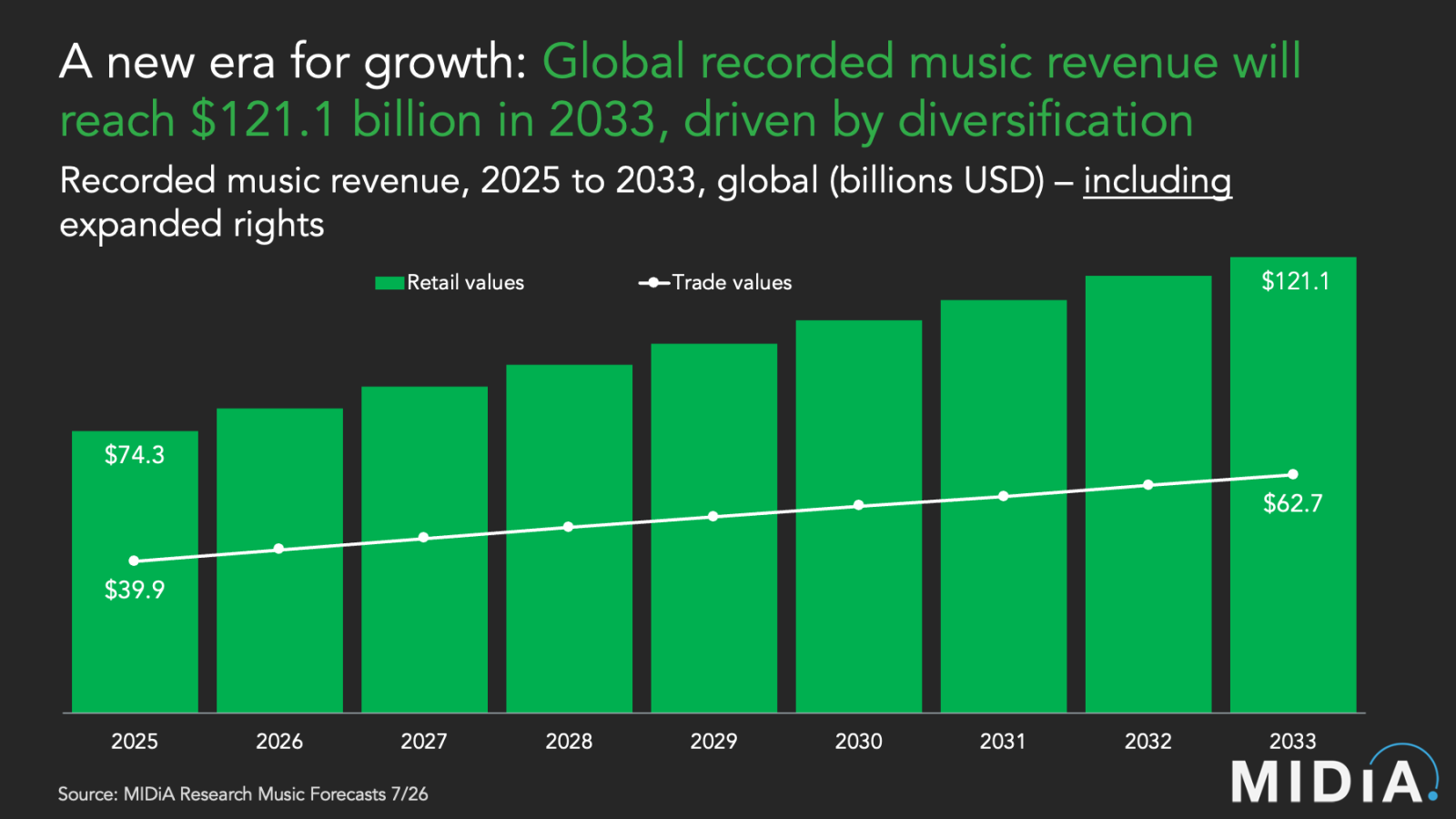
MIDiA Research 2026–2033 global music forecasts | A diversifying market
This blog post was co-authored by MIDiA's Head of Data, Perry Gresham , and Vice President of Music Strategy, Tatiana Cirisano . It’s now mid-summer, which can only mean one thing at MIDiA: our annual global music forecasts have arrived.
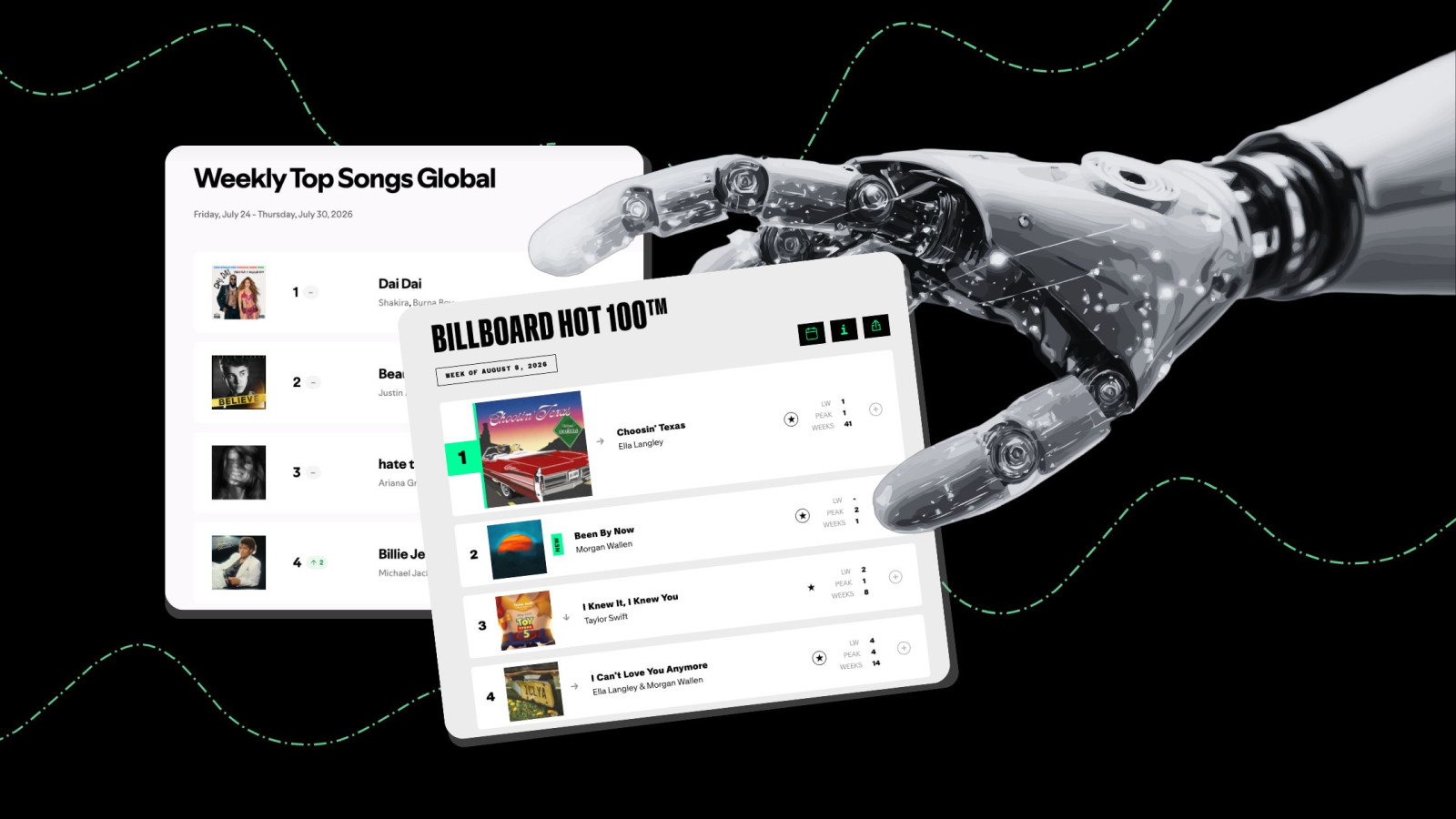
Why have we yet to hear an AI-generated hit?
The biggest fears AI stokes are most often rooted in displacement. Generative AI music models are trained on vast quantities of existing music and capable of producing songs that are catchy, enjoyable, and even beautiful.
Why music is not enough for an artist fan club
With 90,000 AI-generated tracks uploaded to Deezer every day(at time of writing), AI-generated music now constitutes the majority of new releases on the platform. Music was an oversaturated world before AI, with 60,000 tracks released a day in 2021, but a threefold increase in five years makes that ...
What it takes to make a music streaming subscriber switch services
For years, choosing a music streaming service was perhaps less of a decision than an accident. At least in Western markets, the major DSPs have offered similar catalogue, feature sets, and user interfaces, giving consumers little reason to choose one over another.
The biggest album launches happen off streaming – here’s how it can win them back
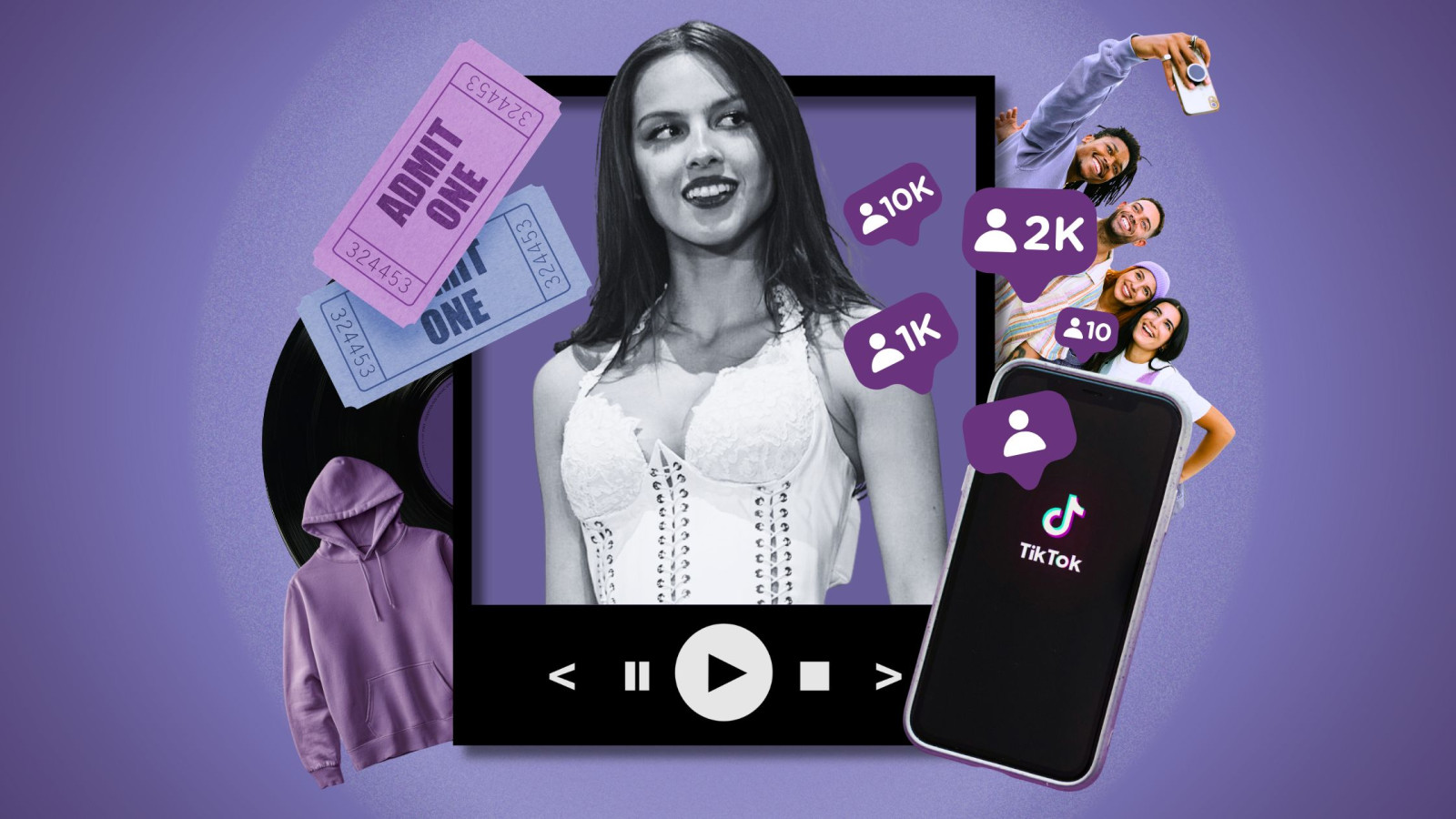
Album marketing rollouts are moving to centre stage as a growing number of artists and labels incorporate interactive experiences into their digital album promotions. For example, with Olivia Rodrigo’s recent release you seem pretty sad for a girl so in love , TikTok launched an in-app experience ...
Gender inequity in creative industries is a structural problem. It's time we addressed it like one
Gender inequity in creative industries is often treated as a series of one-off incidents – individual acts of bias, isolated pay gaps, or a singular unsafe workspace. This fragmented view is, itself, part of the problem.
The future of the music creator economy
AI is a black swan event for music, intertwining the futures of the creator economy and the music industry. The number of gen AI music monthly active users (MAUs) nearly tripled between 2023 and 2025, adding nearly nine times as many users as the global base of musicians over the same period.
AI attitudes by DSP: See which platform’s users embrace AI the most – and why
Over the last few weeks, much has been written about music streaming platforms’ approaches to AI transparency, moderation, and adoption, which are often vastly different . Just as DSPs differ in their approaches to AI, it turns out that their userbases differ widely on their attitudes towards th...
Why now is the time for the creator right
YouTube’s Lyor Cohen and the Recording Academy’s Harvey Mason Jr. recently penned an op-ed for Variety in which they made the case for the NO FAKES act being seen as the starting pistol rather than the finish line.
Superfandom in an anti-social media world
For the past five years, TikTok and digital reach have largely dictated music marketing. For many artists, success has meant being an influencer first and an artist second. The idea of “ 1000 true fans ” shifted from cultivating a dedicated audience willing to buy tickets for your shows to focus...
Music subscriber market shares Q4 2025: The chess board is set
Global music streaming subscribers grew 10.1% to reach 921.6 million in 2025, according to MIDiA’s just-published music subscriber market shares report . While growth slowed compared to 2024, it remained in the double digits, with the 1 billion subscriber landmark now firmly in sight.
Atomised concentration: How streaming ensures the house always wins
There is an apparent paradox in today’s streaming-dominated music market: major labels are losing share (on a distribution basis) yet long-tail indies are finding it ever harder to achieve scale. So, is the trend fragmentation or concentration? The perplexing answer is that it is both.
K-pop fans are not “one size fits all”: Comparing fans in US and South Korea
K-pop has had a banner year, with the genre earning multiple Grammy nominations,along with the massive success of Kpop Demon Hunters . As K-pop’s dedicated fans dominate the global stage, they are often seen as the definition of “superfans”, with artists and labels chasing similar levels of fa...
The music industry’s personalisation paradox
Music streaming, like most other digital entertainment types, has never been more personal. Every listener is now super-served their own algorithmically-generated world of personalised playlists, AI DJs, and hyper-specific recommendations.
The creative generation wants its own soundtrack
Most music fans are musically creative. This doesn’t necessarily mean they aspire to be artists or producers, but simply that they are engaged in at least one of the musical creativity behaviours tracked by MIDiA, such as producing music, learning or playing an instrument, writing music, performin...