
Why have we yet to hear an AI-generated hit?
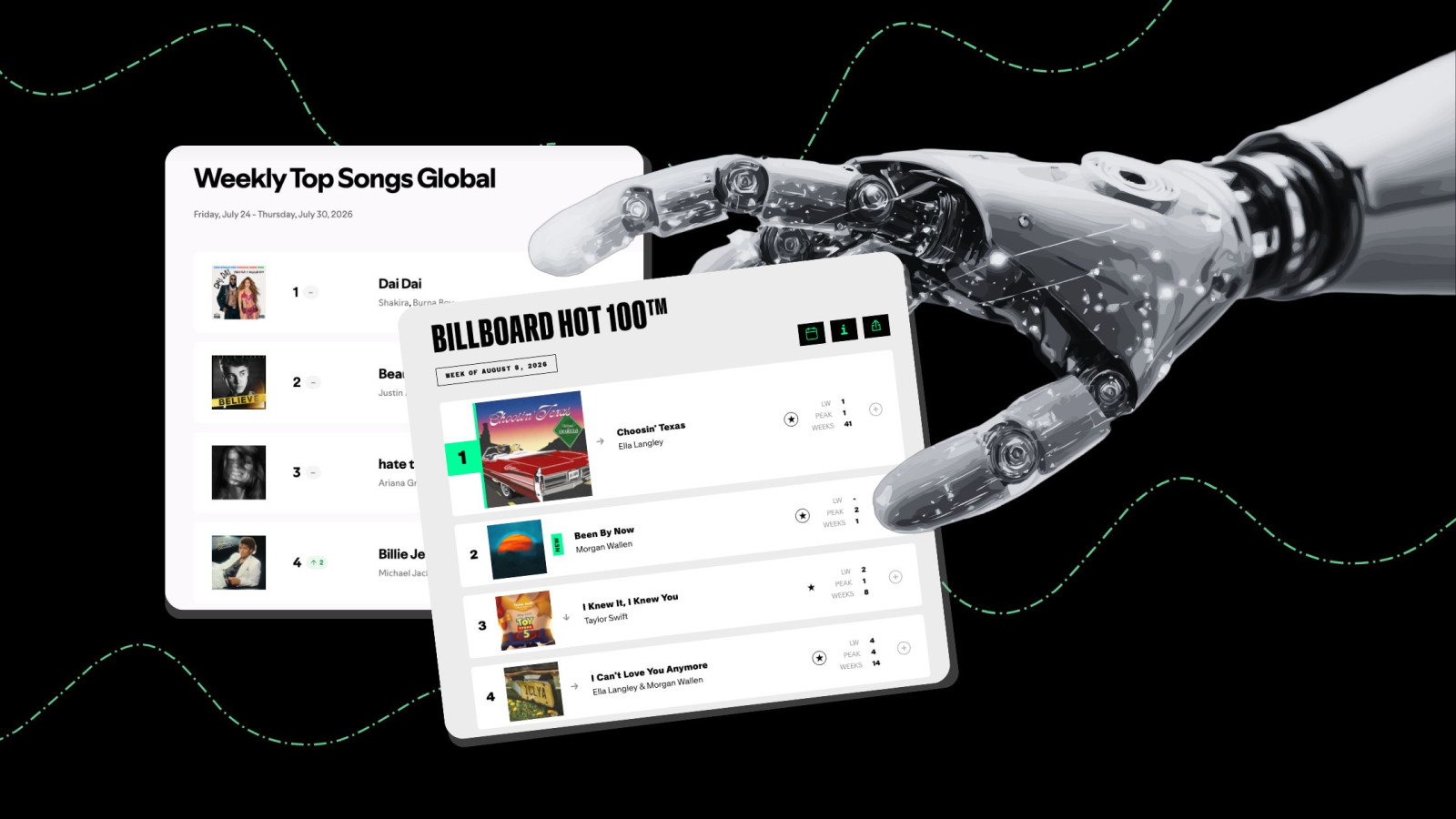
Photo: Image made with Canva Pro

6 Aug 2026
Categories
Companies
The biggest fears AI stokes are most often rooted in displacement. Generative AI music models are trained on vast quantities of existing music and capable of producing songs that are catchy, enjoyable, and even beautiful. Those tracks then often compete for listening in the same spaces as the catalogues they are trained on, with fully AI-generated tracks now exceeding 50% of daily uploads at peak, per Deezer.
It’s now been more than three years since generative AI music broke into the mainstream consciousness. So why is AI-generated music yet to produce a genuine hit?
This isn’t a leading question. AI artists like Xania Monet and Breaking Rust have landed on genre-level music charts or picked up viral wins, and as Rolling Stone highlights, AI is certainly creeping into professional studios. Yet AI-generated music has not yet broken a major music chart like the Billboard Hot 100 (and following IFPI’s new eligibility guidelines, may not have the chance to in many markets), nor has it captured the zeitgeist to become a genuine cultural hit.
The reasons may have less to do with audio quality, and more to do with what a “hit” actually constitutes today, both structurally and culturally.
Featured Report
Splice x MIDiA Sounds of 2026 House on the rise
We zoom in on the trends and microtrends driven by the music industry’s biggest fans and most influential tastemakers: creators. Turn page after page of trends unfolding in real-time and see how Splice’s dataset is the barometer for the state of music today.
Find out more…Breaking through is a challenge, human or AI
The first explanation is the most obvious. The growing volume of music releases, the fracturing of music consumption, and format competition all contribute to an environment where truly “mainstream” hits are fewer and further between, if they still exist at all. While AI is exacerbating this trend, it was already the case well before. So while generative AI may win the “supply” game, it has barely made a dent in demand, with Deezer reporting that generative tracks account for only between 1-3% of its streams.
Cultural context matters
AI models may be trained to reproduce the sonic patterns of past hits, but the thing that made those songs hits was never purely sonic to begin with. Songs that manage to break through the collective consciousness and drive cultural moments are those propelled by a story: a persona, a controversy, a strong aesthetic identity, a live performance that resonates. Take Bad Bunny spotlighting one of New York’s last Puerto Rican social clubs, Charli XCX’s Brat developing its own language, or Kendrick Lamar’s “Not Like Us” being rooted in an era-defining rap beef.
Averaging towards past hits misses the point
While the much-discussed “Gen Alpha melody” indicates that hits converge on similar song structures, hits arguably emerge just as often by breaking patterns. Recently, the success of Rosalia’s 13-language album, LUX, or math rock band Angine de Poitrine’s subversive sound indicate that risk and surprise are the jagged edges that culture tends to catch on. This is why what humans do with AI is more likely to produce a hit than AI generation on its own.
Infrastructure is becoming king
Even so, an artist can have great, boundary-pushing music and a strong story and still struggle to be discovered, much less reach mainstream recognition. That’s where label and DSP support comes in. Ironically, the democratisation of access has only raised the importance of the very systems it was meant to dismantle. Label machinery still matters (and is largely being used to block AI music from any chance at success). Meanwhile, more power is accruing to streaming infrastructure that decides how content is ingested, organised, surfaced for discovery, and monetised. Streaming platforms are increasingly intercepting gen AI music, with Deezer excluding it from algorithmic recommendations. Back in January, an AI-generated track did seem on its way to becoming a hit in Sweden – before it was banned from the country’s music charts (per the BBC).
What it all means
With audio quality no longer the differentiator it once was, the songs that move culture are separated by their ability to do three key things:
- Connect with audiences beyond sound, through context, identity, and storytelling
- Take creative risks that upend rather than simply reproduce listener expectations
- Win the systems that concentrate attention, or else forge a path outside of them
That said, AI not yet generating a hit doesn’t mean that it won’t. Qualities like risk, surprise, and storytelling may feel distinctly human, but are not out of the realm of AI’s possibilities. Nor is the potential for labels or streaming platforms to use their machinery to push AI-generated music, or for AI companies to build music industry infrastructure (as Suno is now going for). In fact, if generative AI platforms become self-contained creation and consumption siloes with their own label infrastructure, pushed out from the traditional music industry, it could create a new bifurcation – separating hits within the AI world from hits outside of it.
If the question we started with proves one truth, it may be this: making music and making music matter are very different things.
Want the latest entertainment research and insights directly to your inbox? Our newsletter has you covered, click here to subscribe.
The discussion around this post has not yet got started, be the first to add an opinion.