
The Podcast Show 2026: The signals worth paying attention to

29 May 2026
Tags
Categories
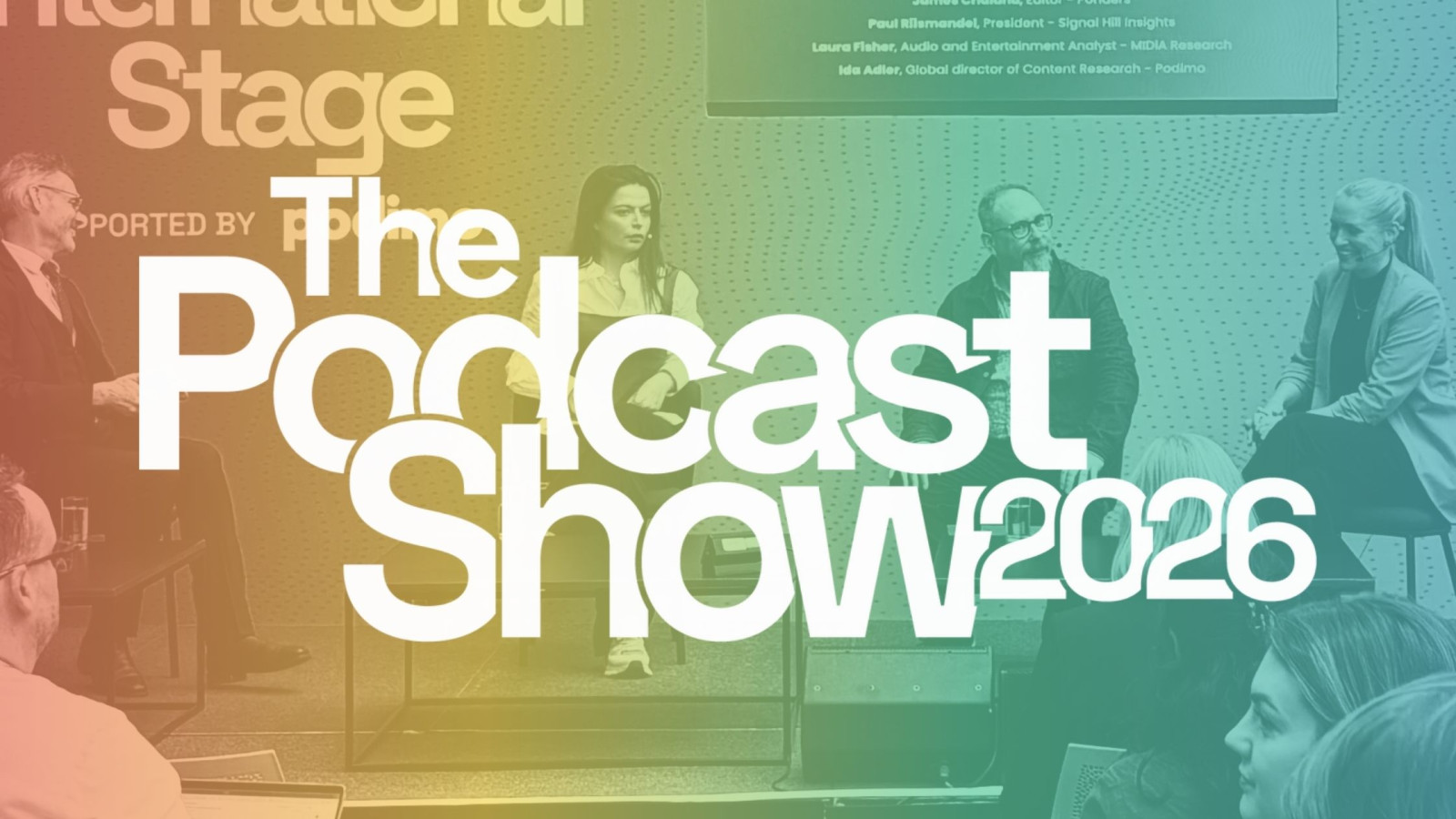
The Podcast Show 2026 reflected an industry entering a more mature and commercially sophisticated phase. While previous years of often focused on podcasting proving its value within entertainment and media, this year’s conversations centred far more on sustainability, audience growth, and long-term positioning.
Several themes emerged across the event: the expansion of video podcasting, the importance of intimacy and community, the rise of podcast internationalism, and a broader recognition that podcasting is no longer evolving along a single path or locality. Rather than converging around one model or market, podcasting is increasingly becoming a multi-format ecosystem shaped by different audiences, behaviours, and commercial strategies.
Podcasting is becoming a multi-format medium
Video was one of the defining themes throughout the conference. Conversations from platforms, publishers, and creators all pointed towards a future where video becomes an increasingly important layer of the podcast ecosystem.
Apple Podcasts discussed further investment in video infrastructure and integrations, while broader platform conversations framed podcasting less as a standalone audio category and more part of a wider creator ecosystem.
There was clear acknowledgement across the industry that not every podcast benefits from video. Some formats lend themselves naturally to visual engagement and short-form distribution, while others remain strongest as audio-only experiences.
This increasingly supports MIDiA’s broader bifurcation of audio thesis: podcasting is not becoming one thing. Instead, different formats are emerging for different audience needs. For some podcasts, video creates stronger discovery opportunities and additional monetisation pathways. For others, particularly narrative formats or audio dramas, their strength lies in remaining audio only.
Intimacy remains podcasting’s greatest strength
Despite the continued focus on scale, some of the strongest discussions throughout the event reinforced podcasting’s core differentiator: intimacy. Sessions around mental health, documentary storytelling, and audience relationships repeatedly highlighted how podcasts create uniquely personal listening experiences.
Audiences actively choose the voices they spend time with, often listening alone and in highly individual contexts. This relationship dynamic helps explain why podcasting continues to be such an effective environment for trust-led advertising and community-driven engagement. Hosts increasingly function less like broadcasters and more like trusted companions.
Featured Report
The hunt for tomorrow’s platform Are games the next generation of social?
Games environments now serve as important social hubs for younger audiences. Networks form around these shared worlds first and traditional channels second, creating communities that persist whether users are actively playing or not. Simultaneously, mainstream social platforms are becoming increasingly focused on passive entertainment, leaving a so...
Find out more…One particularly interesting nuance is the distinction between podcasting and traditional speech radio. Podcasts feel conversational rather than performative, shaped by the assumption that the host is speaking directly to an individual listener rather than to a broad audience. As David Dimbleby said during the show, “I narrated [the podcast] as I was speaking to my granddaughter”, before going on to articulately describe why that difference in tone matters.
Podcasting’s international growth opportunity
There was a growing sense throughout the conference that podcasting is becoming less US-centric and more internationally diverse. Discussions centered around emerging podcast markets and the idea that growth opportunities outside the US may become increasingly important over the next phase of the industry’s development.
What’s emerging is not simply podcast globalisation, but podcast internationalism – a landscape with several different poles, rather than there being one podcasting North Star.
Community is becoming central to podcast growth
Another major theme throughout the conference was the increasing importance of audience specificity and community identity. Conversations focused on the notion that podcasts no longer necessarily have to reach the broadest possible audience to be successful, but can instead foster highly engaged communities with strong cultural alignment.
Community was framed not just as an engagement tool, but as part of the commercial model itself. Audience loyalty, fandom, and
participation are increasingly central to retention, monetisation, and long-term growth. In many ways, podcasting now mirrors broader shifts happening across entertainment, where belonging, audience affinity, and fandom are becoming as important as scale.
Plurality is becoming podcasting’s defining feature
Perhaps the most interesting takeaway from The Podcast Show 2026 was not technological, but structural.
Podcasting increasingly feels less like an emerging medium trying to emulate existing formats, and more like a mature pillar of the entertainment industry with its own commercial logic, creative language, and audience behaviours.
That distinction is important because many of the polarising conversations of the event – audio versus video, scale versus intimacy, platforms versus communities – are in fact not indicative of conflict or instability at all but indicative of expansion.
As podcasting grows, different models to do so are emerging. Some podcasts are becoming visual entertainment brands built for social ecosystems and mass discovery. Others are leaning further into intimacy, trust, and highly engaged niche communities.
Rather than dividing the medium, this fragmentation may ultimately strengthen it. Podcasting’s future advantage may lie precisely in its flexibility: its ability to support multiple formats, audience behaviours, and business models at once.
The Podcast Show 2026 signalled that the next phase of podcasting will not be defined by convergence around a single model or market, but by a growing confidence in plurality.
Want the latest entertainment research and insights directly to your inbox? Our newsletter has you covered, click here to subscribe.
There are comments on this post join the discussion.