
MIDiA Research 2026–2033 global music forecasts | A diversifying market

13 Aug 2026
Categories
Companies
This blog post was co-authored by MIDiA's Head of Data, Perry Gresham, and Vice President of Music Strategy, Tatiana Cirisano.
It’s now mid-summer, which can only mean one thing at MIDiA: our annual global music forecasts have arrived.
How much revenue will the recorded music industry generate?
Global recorded music industry revenues will reach $121.1 billion in retail terms by 2033. That figure includes DSP / retailer and publishing revenues deriving from recorded music, as well as labels’ share of revenue from expanded rights (such as that from merch and live).
As is normally the case, the real story is how the segments underpinning that growth will evolve – and who will benefit the most.
How do we forecast the future of the music industry?
First, a look under the hood. Forecasting the music industry would be easy if we could assume tomorrow behaves like today. But with continued disruption from AI, music streaming’s foray into wider entertainment, and real questions about future subscription tiers being worked out in real-time, it is only becoming harder to build an accurate view of what’s to come. So how does MIDiA do it?
In an age of instantly-generated analysis, MIDiA's models are built for depth, precision, and long-term accuracy. Every one of our 1,500+ lines of model output is underpinned by analytical thought and faces critical review. Combining financial reports, proprietary label and consumer survey data, and stakeholder interviews with industry expertise, our 2026 music forecasts are the product of hundreds of hours of modelling work across the team. Working hand-in-hand with our music industry analysts, we’ve combined these inputs to produce a comprehensive and realistic view of the music industry’s future.
This approach leads to consistently strong results: last year’s forecast was just 0.1% off 2025 actuals for total revenue, and since 2022, MIDiA’s music forecasts have averaged 3.7% difference from market actuals for the subsequent year.
This year saw particular focus on average revenue per user (ARPU) modelling for subscriptions, specifically the following:
- Tier mix: Increased precision for tier mix figures via new MIDiA Research consumer survey data
- Local pricing: MIDiA collected more than five years’ worth of local price data across DSPs, tiers, and countries (e.g., Germany Spotify family plan cost in 2023)
- Price increases: Country-level forecasts for price increases by tier, deriving from frequency of price increases by DSP and tier
- Churn, trialists, and conversions: Enhanced modelling of subscriber flows between trials, subscription tiers, and cancelled / retained subscribers
- Bundling and Discovery Mode: The impacts of bundling and Discovery Mode on ARPU and label trade share were modelled in increased detail
Our model provides a framework to calculate ARPU across all regions and determine its future pathway as factors like subscriber growth, tier mix, pricing, trial provision, trial conversion, and churn evolve over time. While taking into account all of these considerations is not the fastest way to produce a forecast, that's precisely the point. Our forecasts are designed to give us confidence in every number, so our clients can have confidence in them too.
Featured Report
MIDiA Research 2026–2033 global music forecasts A diversifying market
This report presents the key figures, trends, and drivers of MIDiA’s music forecast model. This includes users and revenues across subscription, ad-supported audio, and ad-supported video streaming, physical, expanded rights, sync, performance, and more.
Find out more…What are the key drivers of the future of the global music industry?
Some of the key drivers up to 2033 are subscription average revenue per user (ARPU) growth, DSPs continuing to pull new levers, a growing importance of the fan economy, the Global South, and Ad-supported audio.
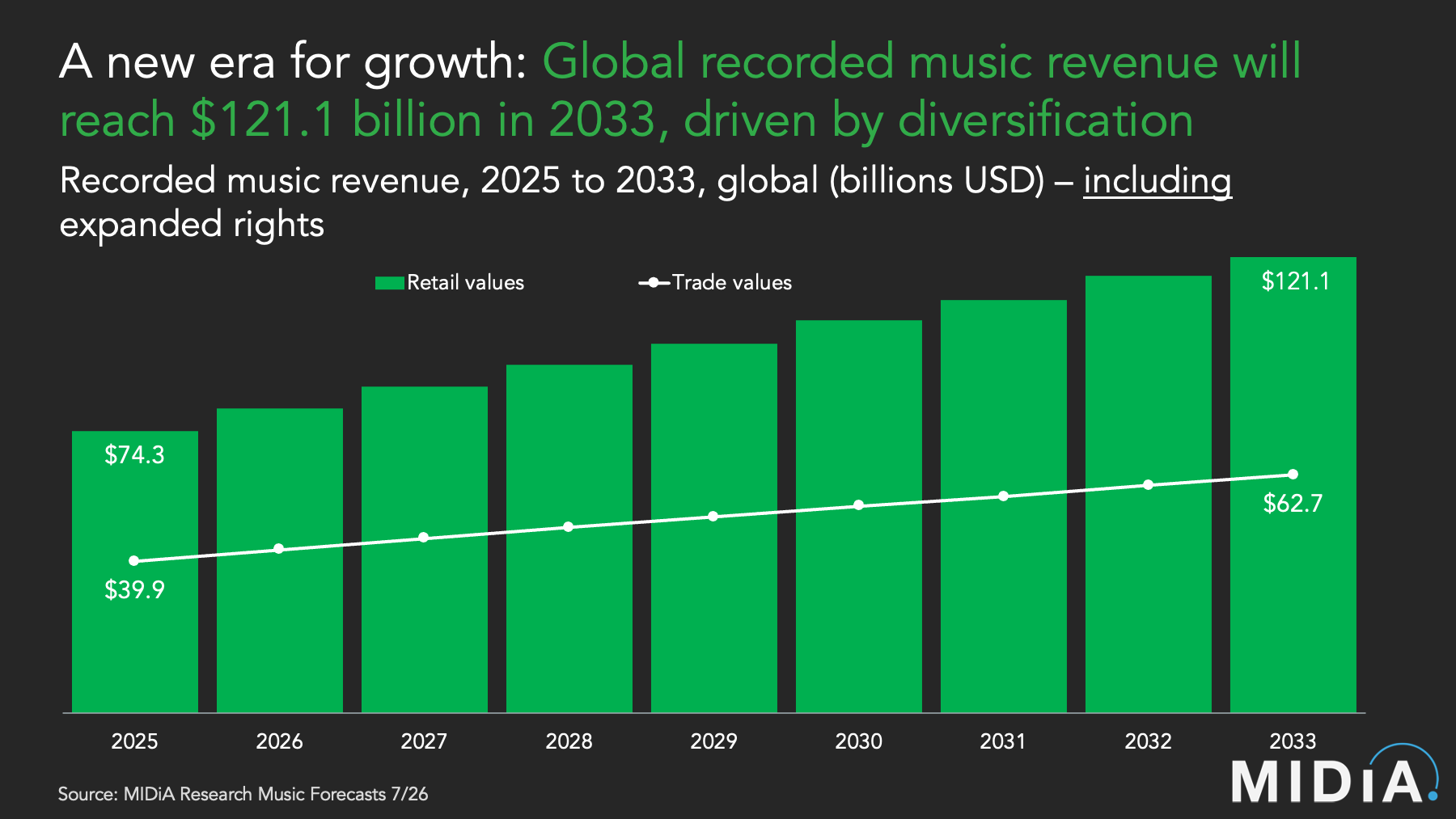
After a solid 2024, global recorded music revenue growth accelerated to 11.4% in 2025, reaching $74.3 billion in retail terms including expanded rights. Expanded rights were key to growth in fact, growing twice as fast in 2025 as the rest of the market.
The impact of expanded rights underlines our title for this year’s report: A diversifying market. Yet this is just one of several forces making the industry more dynamic and multifaceted. The years to come will be shaped by five key shifts:
1. Streaming is growing up
As the streaming market matures, the industry has explored steadier price increases as well as format innovation (e.g., new tiers). We will see the fruits of this labor in the years to 2033, starting with a return to subscription average revenue per user (ARPU) growth in 2026. The trade-off will be dampened user growth as subscribers hit their limits for willingness to pay, and the free-trial flow is tightened
2. But not all streaming growth is equal
A notable shift over recent years has been the changing rights structures and resulting revenue shares between DSPs and rightsholders. Retail revenue is growing faster than trade – and that gap will widen as DSPs continue to pull new levers: bundling carve-outs, format diversification, Spotify's Discovery Mode, and more.
3. The importance of the fan economy
While streaming remains the core revenue driver, the fan economy – a catch-all term for revenues from non-DSP streaming, physical, and expanded rights – is increasingly important. Expanded rights will see the second fastest growth of any industry component, behind only streaming. Physical will mostly hold its size over the forecast period, rather than maintaining 2025’s strong growth, but this endurance represents its value as a fan product. A positive trajectory for non-DSP revenues illustrates the importance of seeking new music licensing opportunities across social, gaming, and fitness. Vitally, while each component of the fan economy generates revenue directly, they also represent different facets of fandom – itself the ‘fuel’ for consumption-based revenue via streaming.
4. The Global South is no longer a new story – but the biggest rises are still to come
Two years ago, MIDiA’s global music forecast was subtitled “Rise of the Global South”. Since then, the biggest shifts in country revenue share have been a circa 2% percentage difference fall in share for the US and a circa 1% rise for China. Emerging markets like Sub-Saharan Africa and MENA (Middle East and North Africa) have slightly gained share but we are still to see their full revenue potential. India lost overall revenue share in 2025 but is forecast to gain the most share of any market from 2025 to 2033.
5. Audio ad-supported will remain a growth hotspot
Despite a weak 2025, ad-supported audio has a very positive forecast outlook. While premium subscriptions will add more absolute revenue ($ terms), ad-supported audio revenue will be the fastest growing industry subcomponent in CAGR terms in the years to 2033. Emerging markets will see particularly high growth rates tying in with streaming adoption.
If the above has piqued your interest, we have made a preview version of this year’s report available for free for everyone via our Global Music Forecasts page. This exclusive deck includes:
- Key trends for the industry
- Total market size, 2025 and 2033
- Global subscriber ARPU trajectory, 2025-2033
- Top five music subscriber markets, 2025 and 2033
- Top five music subscription revenue markets, 2025 and 2033
- Fan economy revenue, 2025 and 2033
- Industry definitions and classifications
- More detail on MIDiA’s forecast methodology
MIDiA clients can find the 79-page report and 50+ tab Excel sheet here.
A preview version of this report is available free for everyone via our Global Music Forecasts page.
If you are not a client but would like to learn how you can gain access to this report, please reach out to info@midiaresearch.com.
Image updated on 18/08 to state that $121.1 billion revenue would be reached in 2033.
Want the latest entertainment research and insights directly to your inbox? Our newsletter has you covered, click here to subscribe.
The discussion around this post has not yet got started, be the first to add an opinion.