
Culture shock: What 10,500 labels reveal about the Global South's genre story

Photo: Image made with Canva Pro

30 Oct 2026
Categories
Companies
At MIDiA, we have been pointing to the rise of the Global South for many years, so it is good to see that the message is catching on. And it’s not a moment too late, considering that Global South markets have been the main drivers of subscriber growth throughout this decade.
Yet it’s easy to downplay the importance of these markets to the global streaming economy because their lower average revenue per user (ARPU) means they are still a minority of revenue. However, quantity will ultimately prove to have its own quality. Nowhere will this impact be seen clearer than in genre. Throughout the 20th century and beginning of the 21st, Western repertoire – particularly Algo repertoire – dominated global revenues, with the US enjoying a de facto monopoly of music export revenues.
This is all set to change.
Over the course of the last few months, the MIDiA team has been busy building a major new data source that will provide a set of previously unseen global market insights. We have been mapping ten and half thousand record labels by country, revenue, genre, distributor, and a whole lot more. Ahead of the forthcoming release of two MIDiA reports analysing this dataset, I’m going to explore some of the preliminary genre trends here.
We looked at the genre of record labels in terms of share of revenue, streams, and number of labels. The headline figures tell a predictable story, that mainstream genres like rock, pop, and hip hop dominate all three metrics. Meanwhile, Global South genres (e.g., Afrobeats, amapiano, K-pop, Arabic pop, Bhangra, Punjabi hip hop, phonk, sertanejo, cumbia, etc.) have around a fifth share of all three metrics. But it is the detail beneath the surface where things start getting interesting:
Featured Report
Global South rising Streaming audiences in China, Turkey, and South Africa
It is increasingly clear that the future of the global music streaming business relies heavily on the Global South markets, which include Latin America, Asia Pacific, and the Rest of World. Most subscription growth is coming from these regions, which will collectively dominate the global music subscriber base by 2031, according to MIDiA’s global ...
Find out more…- Global South genres have a higher share of labels than revenue
- Earlier stage regions like Sub-Saharan Africa (SSA) and Middle East and North Africa (MENA) have a dramatic drop off from streams share to revenue share (in some cases revenue share is more than three times smaller than stream share)
- Global South genres are in fast growth markets
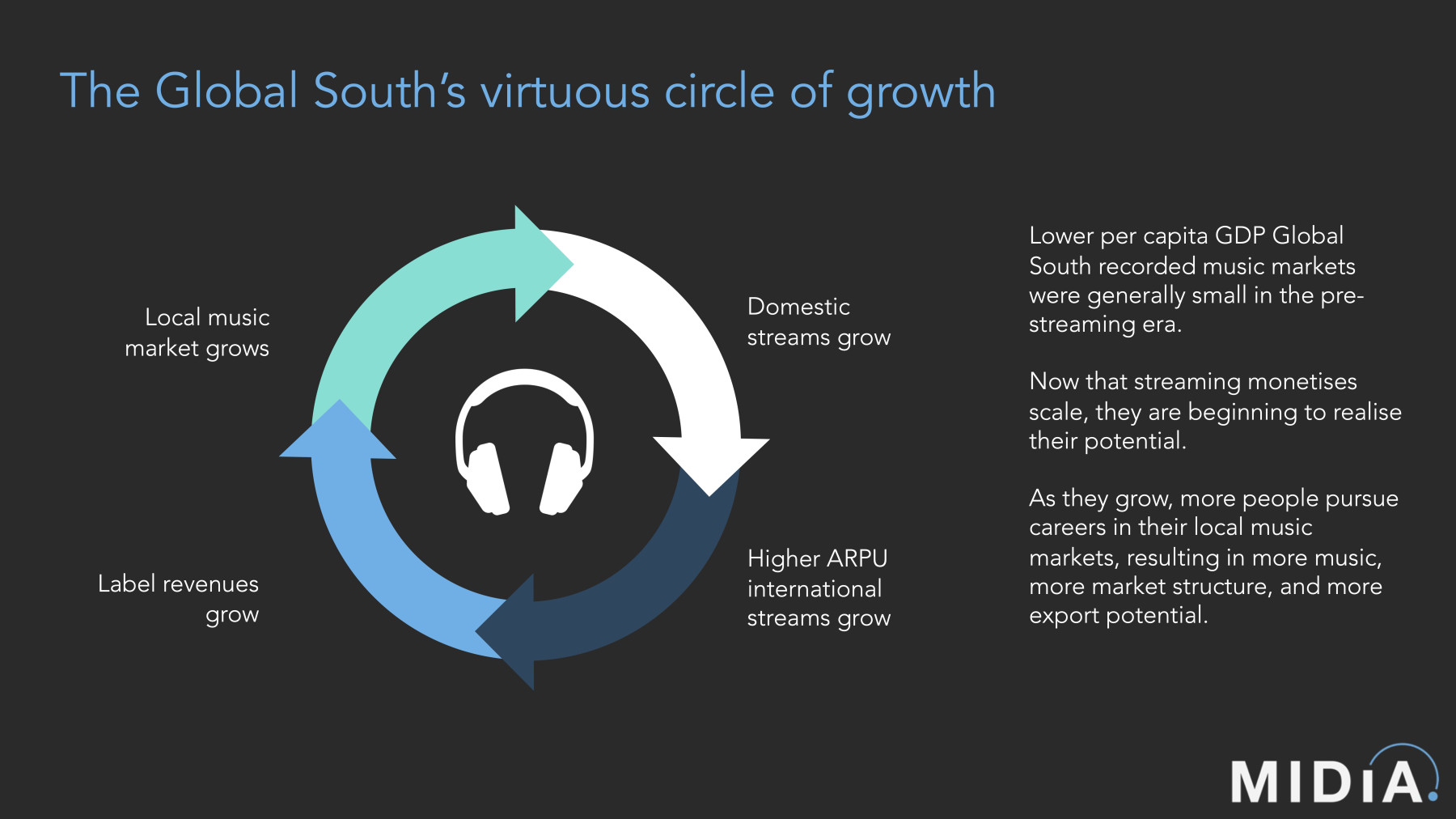
When considered together, these factors point to a crucial market dynamic: Global South genres are just getting going. They are building momentum that is not yet reflected in revenue figures. Over the next few years, we will see two key dynamics play out:
- The streams-to-revenue share gap will narrow in markets such as Brazil, Mexico, and India due to strong subscriber growth, which shifts the streams balance from lower ARPU ad supported, to higher ARPU premium
- Streams growth will accelerate across all Global South markets, but particularly in earlier stage regions like MENA and SSA
The first will be most visible, most quickly. But the second will be most important. Why? Because a growing number of Global South genres will start developing so much stream scale in their local markets that they will hit global streaming charts which will, in turn, fire up the recommendation algorithms and push this music to wider audiences. This is exactly the path that reggaeton followed, nearly a decade ago.
Right now, labels in regions like SSA and MENA export five times less of their music than US and European labels do. When their growing domestic streams trigger international volumes (travelling via diaspora populations), they will take a share of high-ARPU Western royalties. Global South labels’ export streams will disproportionately contribute to their revenue bases. Any smart label will quickly see the business model benefit of targeting Western listeners.
So, the coming years will see more Global South genres competing for both the culture and revenue of Western markets. Which means that Western rightsholders will face a double whammy of lower repertoire share in fast growing regions and increased share competition in their own core regions. Western rightsholders are of course actively pursuing Global South M&A strategies, but no amount of acquisition is going to be sufficient to keep up. The global cultural balance of trade is shifting.
There is, though, one scalable strategy available to Western labels: distribution. Western distributors and big labels have become the supply chain infrastructure of the Western streaming market. The opportunity to replicate this in Global South markets is clear. A small number of Western players saw the opportunity early, most notably Believe. Believe did not get much credit for building out sales teams years ago in nascent streaming markets but it is now set to reap the benefit of strategic foresight. For example, Believe distributes around half of all Turkish labels that feature in the top 10,500 labels globally. As Global South genres grow, so will it.
Keep a look out for our forthcoming State of the independent music economy report which will provide deep, detailed data and analysis of this 10,500 label dataset. This will be followed by a distributor’s market shares report.
If you are not yet a MIDiA client and would like to learn more about how to get access this research, please email businessdevelopement@midiaresearch.com
Want the latest entertainment research and insights directly to your inbox? Our newsletter has you covered, click here to subscribe.
The discussion around this post has not yet got started, be the first to add an opinion.