
From pirate to premium: Crunchyroll has transformed from a pirate streaming service to the premium anime consumption experience, with over 1,000 titles across 248 markets. The number of subscribers paying for access has increased from 5 million to more than 15 million between 2021 and August 2024. Crunchyroll’s subscription tiers are sensitive to the low spending power of younger consumers. The service keeps the funnel wide by offering free access to a limited number of shows via an ad-supported tier. Its cheapest ‘FAN’ membership provides ad-free viewing and unlimited access to content at $7.99, compared to Netflix’s ad-free standard subscription at $17.99.
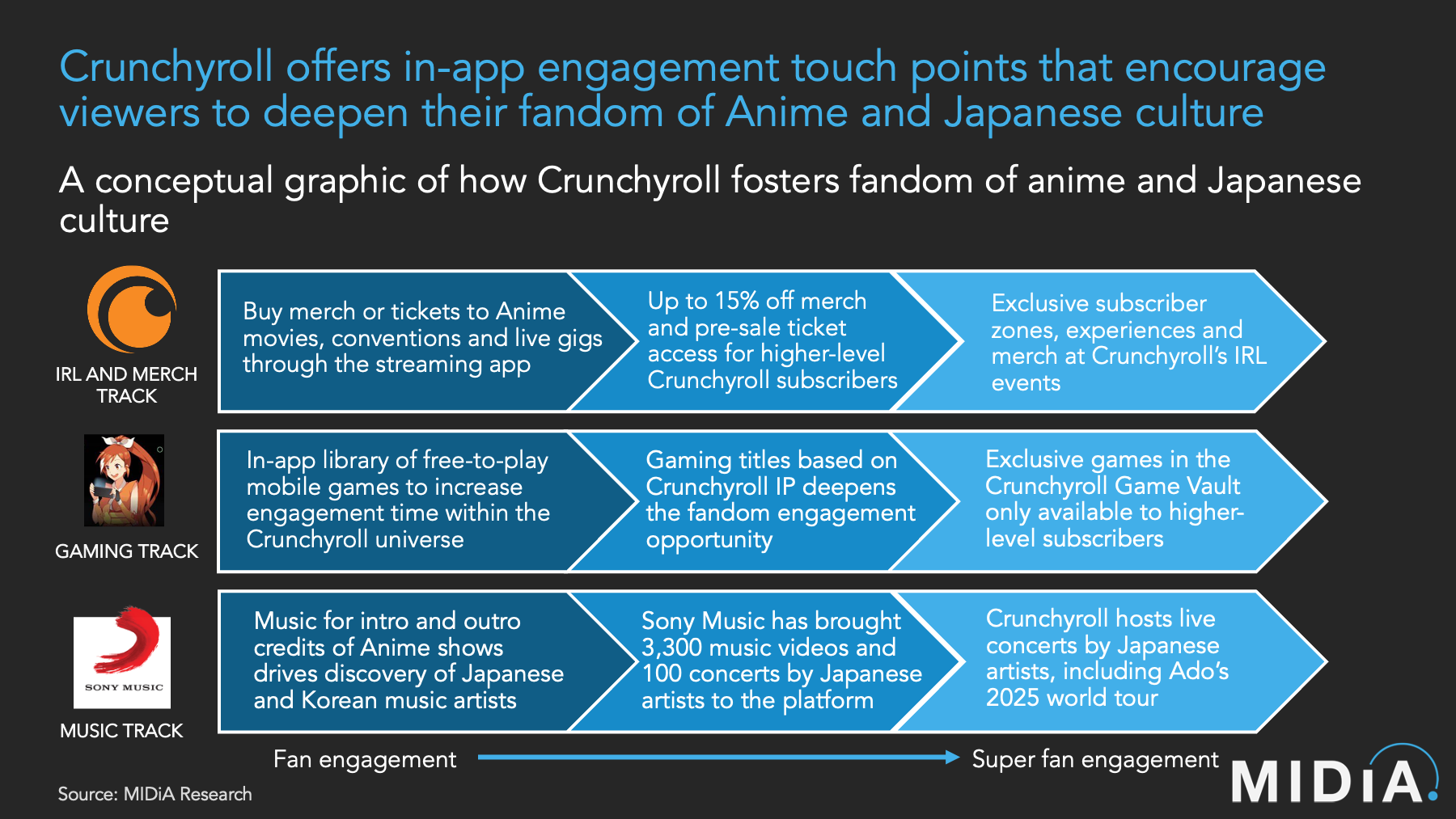
On-platform engagement: Crunchyroll uses fandom commitment as a framework for marketing its subscription tiers. An ad-supported free-tier enables viewers to watch a limited number of shows. However, the Fan ($7.99 per month), Mega Fan ($11.99 per month), and Ultimate Fan ($15.99) subscription does more than provide varying levels of anime access. It incentivises anime fans to keep their engagement behaviours on platform, rather than seeking out rival services or social media. For example, Anime fans with a premium subscription who want to buy a collectible can do so in-app through the e-commerce store with a 15% discount rather than using Amazon. That same subscriber can track updates about anime’s theatrical release via the news tab before securing pre-sale movie ticket access on Crunchyroll. And much like the music video partnership, Sony is using its Crunchyroll ownership to deploy a cross-entertainment strategy in games. Crunchyroll is working with Aniplex on an exclusive anime adaption of Ghost of Tsushima, the open-world samurai epic produced by PlayStation Studios for PS4, PS5 and PC. Sony is also funnelling gamer engagement more directly by providing access to several Crunchyroll shows via the Sony Pictures Core catalogue, which is bundled in with PS Plus Premium subscription tier. By engaging with Crunchyroll, brands open a gate to the cross-entertainment ecosystem that anime fans inhabit.
Leveraging the anime community: Key to Crunchyroll’s positioning with anime fans is having a stake in central spaces where anime scenes gather and express their fandom. This includes having a significant presence at Anime Expo, LVL Up, and Awesome Con. During event, it offers exclusive subscriber experiences, such as VIP seating for music performances, free merchandise, and an anime-themed experiences in subscriber lounges. Crunchyroll’s theatrical strategy also funnels streaming subscribers towards movie theatres and vice versa. Distributed by Sony Pictures in partnership with Crunchyroll, Demon Slayer: Kimetsu No Yaiba was the highest grossing anime movie in the US box office in 2024 taking $17.7m. Crunchyroll’s positioning within streaming and IRL experiences gives brands flexibility to not only engage anime fans where they are, but to reach anime super fans who are more committed to spending money to display their fandom.
Elevating anime’s music relationship: Sony has used its ownership of Crunchyroll as a cross-entertainment opportunity to drive more engagement to its music IP. Sony Music has licenced 3,300 music videos and 100 recorded concerts by Japanese artists to the platform. This is not just a means of increasing in-app engagement time with fans who want to watch music videos from their favourite shows. It also supports Crunchyroll’s positioning as a platform for fans who love both anime and wider Japanese pop culture. This content helps to foster a music consumption on the platform that can support Crunchyroll’s IRL music events. The platform is currently supporting a world tour by Ado, the J-pop artist whose songs have appeared in Spy x Family and the One Piece Film: Red.
When scenes collide: Not all Crunchryoll’s measures to help foster the anime community have worked. Crunchyroll disabled its social platform style comment section in July 2024 after a subset of anime viewers left a stream of homophobic comments on Twilight Out of Focus, a romance anime between two male students. This underscores the challenge of catering to a larger scene like anime. Its welter of titles representing multiple genre types, pursuits, and communities attracts a diverse group of fans. Anime titles can promote conservative and liberal standpoints. Some anime titles are criticised for objectifying women; others are promoted for championing female power. Each of these anime fans may feel like they have a stake in the wider anime scene, even if their political and societal views are not aligned. This creates the risk for clashes between constituent groups. The fall-out of which can lead to alienation and the formation of splinter scenes.
Netflix captures casual fans and drives new anime audiences: A more casual anime fan is also being nurtured on Netflix, Amazon Prime Video, and Hulu via the commissioning and distribution of anime content. Like Crunchyroll, Netflix also leans into pop anime titles from the shonen genre. It has around 160 anime series and launches approximately four to six exclusive series per year. Notable originals include Cyberpunk: Edgerunners, Sakamoto Days, and Delicious in Dungeon, but it also distributes the Studio Ghibli catalogue and hit shows like Spy x Family. This breadth of IP has turned Netflix into a key destination for anime fans. Netflix has deployed specific tactics for fostering anime fandom. This includes acquiring the distribution rights to Cowboy Beebop and One Piece to drive engagement towards Netflix’s live action adaptations of those titles. Netflix is also increasing anime discovery among non-fans by treating anime as a medium that spans genres rather than a specific genre type. For example, anime content is served alongside TV shows and movies in the sci-fi carousel rather than being confined to an anime carousel.